Maus Ii Ch. 3 Pre Reading Activities
Reading Questions and Resources for Fine art Spiegelman's Maus (1986, 1991)
last updated Feb. 12, 2022
Timeline of Events in Maus and Spiegelman's Life (back to top)
- 1906, Oct. xi: Vladek Spiegelman born
- 1912, March 15: Anja Zylberberg born
- 1927: Vladek starts his first service in the Smooth army (conscripts must train every 4 years)
- 1937, February. 14: Vladek and Anja marry (he is age 30, she 24)
- 1937, Oct: Vladek and Anja'southward son Richieu is born in Sosnowiec
- 1939, Aug. 24: Vladek is called to serve in the Polish army
- Sept. one: Deutschland invades Poland
- Sept. four: Germans enter Sosniwiec
Vladek is arrested equally a pw - Sept. 28: Poland surrenders
- Nov. 5-6: Jews in Poland must wear an armband or yellow star patch
- Dec. 23: Jewish property in Poland is confiscated
Vladek and Anja's father lose their factories
- 1940, February.: Vladek is released from the POW camp and sent to Lublin
- 1941, Dec.: All Jews in Sosnowiec are forced to alive in the ghetto department
- Dec. 7: Nippon attacks US at Pearl Harbor, US enters World War Ii
- 1942, May ten-12: "Aktion" (deportation) of 1500 from Sosnowiec, includes Anja's parents
- June: 2000 more Jews deported from Sosnowiec to Auschwitz
- Aug. 12: 8000 Jews called to Sosnowiec stadium, then deported to Auschwitz
- Vladek's parents are also deported and murdered in 1942
- 1943, Bound: all remaining Jews in Sosnowiec are sent to Srodula ghetto
Richieu is sent to Zawiercie with his aunt Tosha- Aug. 16: most Jews in Srodula are deported to Auschwitz
Vladek and Anja are in hiding - Aug. 26: Tosha poisons herself, Richieu, her daughter Bibi and her niece Lonia to avert displacement
- Aug. 16: most Jews in Srodula are deported to Auschwitz
- 1944, Jan.: all remaining Jews in Srodula are murdered; Vladek and Anja are still in hiding
- March: Vladek and Anja are sent to Auschwitz; quarantine til mid-May (Ii, 68)
- May-Aug.: Vladek works in Auschwitz tin shop
- Summer: Vladek sees Anja in Birkenau
- Aug.-October.: Vladek works in Auschwitz shoe shop, then can/metal working again
- Sept/Oct: Anja is moved from Birkenau to Auschwitz I
- 1945, January.: Vladek is marched to Gross Rosen (Anja, also, then to Ravensbrück)
- Feb.: Vladek is sent by railroad train to Dachau
- April: Vladek is evacuated from Dachau
- April. 29: Dachau is liberated
- May 7: Deutschland surrenders
- Summer: Vladek is in a U.s. displaced persons military camp in Garmisch-Partenkirchen
- he goes to Bergen-Belsen, learns that Anja is in Sosnowiec, and goes at that place to run across her
- 1946: Vladek and Anja move from Poland to Sweden; Vladek starts a business
- 1948, February. 15: Art Spiegelman is built-in in Stockholm
- 1951: Spiegelman family unit immigrates to US, Art grows up in Queens, New York
- 1965: Fine art attends the High School of Art and Design in Manhattan
- 1968, ca. March: Art has a brief but intense nervous breakdown & is hospitalized
- May 21: Anja commits suicide after Fine art returns home
- Art leaves Harpur higher/SUNY Binghamton (major: art & philo)
- 1970: Art publishes "Prisoner from Hell Planet" (reproduced in Maus)
- 1972: Art publishes "Maus" in Funny Animals (three page comic; one panel, six panels)
- 1975: Art meets the woman he volition marry, Françoise Mouly (b. 1955)
- 1978: Art Spiegelman starts cartoon Maus
- 1979, Aug.: Art and Françoise spend time in the Catskill mountians (NY) with Vladek
- 1980: Art and Françoise showtime the avant-garde magazine RAW
- Art begins cartoon Maus, which is serialized in RAW
- 1982, Aug. 18: Vladek dies of congestive heart failure
- 1986: offset volume of Maus published
- 1987: Fine art and Françoise'southward daughter Nadja born
- 1991: second volume of Maus published
- 1992-: Art starts working for the New Yorker (he resigns some fourth dimension after 9/11/2001)
- 1992: Art wins a Pulitzer Prize for Maus
- 1992: son Dashiell born
- 1993-: Françoise works as art editor at the New Yorker
- 2004: Art publishes In the Shadow of No Towers
- 2005: Art begins publishing a comix format memoir, Portrait of the Artist as a Young !@##$%!, which incorporates some of his most significant early hole-and-corner comix.
He is also assembling a book almost the making of Maus, titled Meta-Maus.
- 2011: Meta-Maus is published (see below)
Links (back to meridian) [links checked Jan. 23, 2012]
- Quotations and Resources well-nigh Maus
- Comprehensive Study Guide (2016) at litcharts.com. It has detailed sections on:
- Context, Plot, Summary-Assay, Themes, Quotes, Characters, Symbols
- All tin can exist read online in expandable sections; downloadable as a single pdf with a $ten subscription
- This is really VERY comprehensive and high-quality
- Chapter summaries, questions, cast of characters and other resources (e.grand. on graphic novels), past the Bucks County, Pennsylvania Free Library project (2005; 2014 web archive version)
- Annotated Bibliography of nine manufactures and book chapters from 1991 to 2003 discussing Maus, by Prof. Marcuse'south student Erin McGrath, Jan. 2008.
- Gratis Maus "Cliff notes" at GradeSaver.com--character sketches, chapter by chapter summaries, glossary, quizzes, etc.
- Maus site with study questions, by Eveyln Burg at LaGuardia Community College in 2005, developed to back-trail a lecture past Spiegelman.
- How do you recollect Vladek and Anja survive Auschwitz?
- Why practice you remember Anja kills herself?
- Explain what yous believe volition happen to Vladek and Mala's marriage?
- What will happen with Vladek and Fine art'due south relationship? Why?
- Why did Spiegelman write this book? Why did he phone call it Maus?
- Why did Spiegelman portray his father's story every bit a comic strip?
- Maus portrays the Holocaust or a genocide. A genocide is a d eliberate and systematic destruction of a racial, political, or cultural group . Exercise you lot know of whatsoever contempo genocides? How are these genocides similar to the Holocaust? How are they different?
- What would you accept done if you were a Jew living in Poland during the 2nd World War? What would you have washed if you were a Pole? A High german? Why?
- How did people survive in Poland during the 2nd World War? How do you think these survivors felt afterwards the war? Why?
- In Maus, Art interviews Vladek nigh the Holocaust. How reliable do you call up Vladek's memory is? Why?
- What happens to people who alive under a terror regime for a long period of time? Should people adapt to a terror authorities? Explicate.
- Chapter past chapter and general study questions, for Cary Henson'due south Honors Composition Seminar at the University of Wisconsin, Osh Kosh, Sept. 2007 (Jan. 2010: web archive version)
- Teacher's Guide and Word Questions from Random Firm publisher
- v study questions by Eric Goldstein at Michigan State, for his 1999 "Focus on American Jewish Civilization" class
- Geri Speace, "Maus," entry in St. James Encyclopedia of Popular Culture. Jan. 29, 2002, at FindArticles.com.
- two quotations about Maus, ane from author Art Spiegelman, published in Oral History Journal in 1987, the other from scholar Stephan Feinstein in Witness and Legacy (1996) (with references). [most links on the page don't work]
- Comprehensive Study Guide (2016) at litcharts.com. It has detailed sections on:
- Online Manufactures and Lectures about Maus due east
- Joshua Brownish, "Of Mice and Retentivity," Oral History Review, Spring 1988. (This seminal exam of vol. 1 is archived on this site [vol. two of Maus was published 5 years afterward this article was published].)
- Michael E. Staub, "The Shoah goes on and on: Remembrance and representation in Art Spiegelman'due south 'Maus'" Melus, Fall 1995. (14 page pdf).
- "Art Spiegelman'southward MAUS: Working-Through The Trauma of the Holocaust," by Robert Leventhal (University of Virginia Dept. of German, 1995), office of his hypermedia sourcebook [March 2006 version courtesy of the web archive]
- "A Generation Removed? A await at the human relationship between Vladek and Art Spiegelman," a somewhat chaotic & incomplete hypertext essay by McGowen at Georgetown Academy
- Ian Johnston's 2001 lecture "On Spiegelman's Maus I and II ," for his in Liberal Studies 112 at Malaspina University-College, Nanaimo, BC, Canada. (2012: courtesy of web archive)
- Oliver, Antonio South. "Art Spiegelman'due south MAUS: A Different Type of Holocaust Literature," a 2002 Georgetown University essay.
- Hillary Chute, "Literal Forms: Narrative Structures in Maus," Indy Magazine, Winter 2005. Has detailed interpretations of eight pages from Maus. [1/x: spider web annal version]
- Martha Kuhlman, "Marianne Hirsch on Maus," Indy Magazine, Winter 2005 [1/10: spider web archive version]
- Print Articles and Book Chapters about Maus
- Bosmajian, Hamida. "The Orphaned Vocalisation in Maus," in: Considering Maus: Approaches to Art Spiegelman'southward "Survival Tale" of the Holocaust, edited by Deborah R. Geis. Tuscaloosa: University of Alabama Press, 2003.
- Doherty, Thomas. "Art Spiegelman's 'Maus': Graphic Art and the Holocaust," American Literature 68, no. 1 (1996): 69-84. (16 page pdf)
- Gordon, Ian. "'Just Seriously, Folks...': Comic Art and History," Review of History of the Comic Strip: Vol. two, The Nineteenth Century by David Kunzle, and Comic Books as History: The Narrative Art of Jack Jackson, Art Spiegelman, and Harvey Pekar by Joseph Witek. American Quarterly 43:2(1991): 341-346. (vi page pdf)
- Levine, Michael G. "Necessary Stains: The Bleeding of History in Spiegelman's Maus," chapter X of Levine'south The Belated Witness: Literature, Testimony, and the Question of Holocaust Survival. Stanford Academy Printing, 2006.
- Mikics, David. "Cloak-and-dagger Comics and Survival Tales," in: Considering Maus: Approaches to Art Spiegelman's "Survival Tale" of the Holocaust. Edited past Deborah R. Geis. Tuscaloosa: University of Alabama Press, 2003.
- Rothberg, Michael. "'Nosotros Were Talking Jewish': Art Spiegelman'southward 'Maus' as 'Holocaust' Product," Contemporary Literature 35:4(1994): 661-687. (27 page pdf)
- Versaci, Rocco. "How Comic Books Tin Alter the Style Our Students Run into Literature: One Teacher's Perspective," The English Journal 91:2(2001): 61-67. (vii page pdf)
- Walser Smith, Helmut (ed.), The Holocaust and Other Genocides: History, Representations, Ideals (Nashville: Vanderbilt Univ. Press, 2002), 100-130. (12 folio pdf)
- Immature, James E. "The Holocaust as Vicarious Past: Art Spiegelman'due south "Maus" and the Afterimages of History," Critical Inquiry 24:iii(1998): 666-699. (34 folio pdf)
- Interviews and Biographies of Art Spiegelman
- Wikipedia Art Spiegelman commodity; and Wikipedia entry for Maus
- Comiclopedia biography of Spiegelman (with pictures from his other comics)
- Don Beau, Interview with Art Spiegelman, WiredForBooks.com, 1991 (47 mins.) [ane/x: spider web annal version--use the "heed" link, not the MP3 link]
- Chris Goffard, "The Man Behind MAUS: Art Spiegelman in his own Words," The Fish Rap Live! (1992 interview)

- Harvey Blume, "Art Spiegelman: Lips," Boston Volume Review, 1995 interview, The championship comes from Spiegelman's controversial 1993 Valentine's Day New Yorker cover showing a Hasidic Jew and a Blackness Woman.
- Art Spiegelman, "Those Dirty Little Comics: The introduction to 'Tijuana Bibles: Fine art and Wit in America's Forbidden Funnies, 1930s-1950s'," salon.com, Aug. xix, 1997. (4 web pages). Near the history of pornographic comics. (2012: from spider web archive)
- Art Spiegelman, "Getting in Touch with My Inner Racist,"Mother Jones, Sept. 1997. About his own racism.
- Susan Stamberg, Interview with Art Spiegelman, NPR Morning Edition, January 26, 2004. Click on "heed." Includes as "web extra" audio of Vladek describing the death of Art's Aunt Tosha, his brother Richieu, and his cousins.
- Comic Autobiography: Art Spiegelman, "Portrait of the Creative person as a Young %@?*!" Virginia Quarterly Review, Autumn 2005- (iv Installments; 2 non available; 3 shows origins of Maus in 1971; excerpt of iv also available--link at bottom of page)
- Art Manager's Club, 2006 illustrated biography
- Pages with more resources (near links are included in a higher place already)
- 1996 bibliography of manufactures about Maus with ca. 110 items, past Steven One thousand. Bergson, librarian at the United Jewish Appeal Federation of Greater Toronto [1/10: web archive version] In June 2012 Mr. Bergson, now a UJA researcher, wrote to me to correct the spelling of his name and advise several articles non all the same listed here:
- "'When Time Stands Notwithstanding': Narrative Organization and Traumatic Immediacy in Art Spiegelman's Maus and In the Shadow of No Towers," in Baskind & Omer-Sherman'south The Jewish Graphic Novel: Disquisitional Approaches.
- "The Raw Signing" by Scott Russo, Jizz #4 (iii-page story) May 1991. Fantagraphics, in which Fine art is fatigued as a Maus and he gives his reaction to Pekar's criticism of Maus.
- Simpsons episode "Husbands and Knives" Nov. 18, 2007 in which Art Spiegelman appears--with & without his Maus mask on.
- Fink #1 [Direct From State of israel It's Fink! (Tales from the Ragin' Region, by Uri Fink)--Comic] amazon.com folio; contains the story I reproduced. See page 10 here.
- Michael Allay's "The Night I Met Art Spiegelman He Just Won the Pulitzer Prize" is offline, but the first 3 pages are archived. In information technology, all the characters are drawn as mice. page one, folio ii, page three. 7/16/13: The full comic series is over again online at: http://babygorilla.com/warehouse/Stories/abate/abate1.html. In the last image, the author-artist removes his mask.
- 1999 bibliography on Maus with 51 articles and 13 reviews, by UC Berkeley librarian Gary Handman. Includes Library of Congress catalog call numbers. (Good if you lot want to head for the library)
- Michigan State'due south library bibliographies of Spiegelman'south works, original publications of Maus graphics, and some secondary works.
- 1996 bibliography of manufactures about Maus with ca. 110 items, past Steven One thousand. Bergson, librarian at the United Jewish Appeal Federation of Greater Toronto [1/10: web archive version] In June 2012 Mr. Bergson, now a UJA researcher, wrote to me to correct the spelling of his name and advise several articles non all the same listed here:
- 2002 linkography on Maus by Holly Schneider. Unfortunately, many links are dead. Includes a brief bibliography. [1/x: spider web archive version]
- Reviews
- Review of the Maus CD-Rom by Roy Rosenzweig, included in his 1995 article "Then, What'due south Next for Clio?: CD-ROM and Historians," originally published in The Journal of American History 81, 4 (March 1995): 1621-1640.
- Short review of Maus by Jill Spud, i of the founders of the U.k. site TheBookBag, 2007 [i/ten: web archive version]
- Books
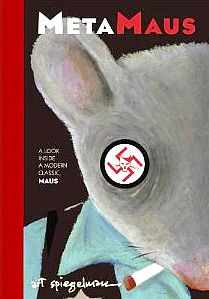
- Art Spiegelman, MetaMaus: A Look Within a Mod Classic, Maus (New York: Pantheon, [Oct.] 2011), 300 pages. ($22 at amazon; Random House page)
"In the pages of MetaMaus, Art Spiegelman re-enters the Pulitzer prize–winning Maus, the mod classic that has contradistinct how we see literature, comics, and the Holocaust ever since information technology was first published xx-five years agone. He probes the questions that Maus nearly frequently evokes—Why the Holocaust? Why mice? Why comics?—and gives usa a new and essential work about the creative process. MetaMaus includes a bonus DVD-R that provides a digitized reference copy of The Complete Maus linked to a deep annal of sound interviews with his survivor father, historical documents, and a wealth of Spiegelman'south private notebooks and sketches."
- Art Spiegelman, MetaMaus: A Look Within a Mod Classic, Maus (New York: Pantheon, [Oct.] 2011), 300 pages. ($22 at amazon; Random House page)
2007: iii,264 folio views; two,890 entry, 2,637 leave ( viii.nine/day)
2008:15,609 page views; 13,995 entry, 13,662 exit (42.half dozen/twenty-four hours)
2009: 31,464 page views; 27,266 entry, 26,684 exit (86.2/day)
2010: 31,747 page views; 27,965 entry, 27,194 go out (87.0/day)
2011: 29,016 folio views; 26,484 entry, 25,572 exit (79.5/day)
2012: 30,311 page views; 27,731 entry, 26,766 exit (82.8/mean solar day)
2013: 20,440 page views; xviii,757 entry, 17,157 exit (56.0/day)
2014: 10,237 page views; 8,839 entry, eight,155 exit (28.0/day)
2016: 12,887 folio views; 11,530 entry, 10,998 get out (30.0/twenty-four hour period)
2017: 9,605 page views; 8,413 entry, eight,131 leave (26.3/day)
2018: 7,658 page views; half dozen,753 entry, 6,505 go out (17.8/day)
2019: 4,566 page views; three,690 entry, 3,497 leave ( 9.vi/solar day)
2020: 9,329 page views; 7,588 entry, 7,295 go out (nineteen.9/day)
2021: page views; entry, exit ( /twenty-four hour period)
Source: https://marcuse.faculty.history.ucsb.edu/classes/33d/33dTexts/maus/MausResources.htm
0 Response to "Maus Ii Ch. 3 Pre Reading Activities"
Postar um comentário