Artist Hans Hofmann Was Known for Art Full of Colors and Shapes Macaroni Glue
| Hans Hofmann | |
|---|---|
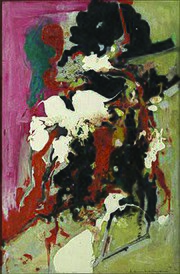 Hans Hofmann, Effervescence, oil, Republic of india ink, casein and enamel on plywood console, 54.375" x 35.875", 1942. | |
| Built-in | (1880-03-21)March 21, 1880 Weißenburg, German Empire |
| Died | February 17, 1966(1966-02-17) (aged 85) New York City |
| Nationality | German-American |
| Known for | Painting |
| Movement | Abstract Expressionism |
Hans Hofmann (March 21, 1880 – February 17, 1966) was a German-built-in American painter, renowned as both an artist and teacher. His career spanned ii generations and two continents, and is considered to have both preceded and influenced Abstract Expressionism.[1] Built-in and educated well-nigh Munich, he was agile in the early twentieth-century European advanced and brought a deep understanding and synthesis of Symbolism, Neo-impressionism, Fauvism, and Cubism when he emigrated to the United States in 1932.[2] Hofmann'south painting is characterized by its rigorous concern with pictorial construction and unity, spatial illusionism, and employ of bold colour for expressive means.[3] [four] The influential critic Clement Greenberg considered Hofmann'due south first New York solo bear witness at Peggy Guggenheim's Fine art of This Century in 1944 (along with Jackson Pollock'southward in belatedly 1943) as a breakthrough in painterly versus geometric brainchild that heralded abstract expressionism.[five] In the decade that followed, Hofmann's recognition grew through numerous exhibitions, notably at the Kootz Gallery, culminating in major retrospectives at the Whitney Museum of American Art (1957) and Museum of Modernistic Art (1963), which traveled to venues throughout the U.s.a., Southward America, and Europe.[6] His works are in the permanent collections of major museums around the world, including the Metropolitan Museum of Art, Tate Modern, Germanisches Nationalmuseum, National Gallery of Art, and Art Institute of Chicago.[six]
Hofmann is likewise regarded as one of the most influential art teachers of the 20th century. He established an art school in Munich in 1915 that built on the ideas and work of Cézanne, the Cubists and Kandinsky; some art historians suggest it was the first modern school of art anywhere.[two] After relocating to the Us, he reopened the school in both New York Urban center and Provincetown, Massachusetts until he retired from instruction in 1958 to pigment full-fourth dimension.[6] His instruction had a significant influence on post-state of war American avant-garde artists—including Helen Frankenthaler, Nell Blaine, Lee Krasner, Joan Mitchell, Louise Nevelson, and Larry Rivers, among many—besides every bit on the theories of Greenberg, in his emphasis on the medium, movie plane, and unity of the work.[four] Some of Hofmann'due south other cardinal tenets include his push/pull spatial theories, his insistence that abstract art has its origin in nature, and his belief in the spiritual value of art.[two] [7] Hofmann died of a middle set on in New York City on February 17, 1966.
Biography [edit]
Hans Hofmann was born in Weißenburg, Bavaria on March 21, 1880 to Theodor Friedrich Hofmann (1855–1903) and Franziska Manger Hofmann (1849–1921). In 1886, his family moved to Munich, where his father took a task with the regime. From a young age, Hofmann gravitated towards scientific discipline and mathematics. At age sixteen, he followed his begetter into public service, working for the Bavarian regime as banana to the managing director of Public Works. He increased his noesis of mathematics there, somewhen developing and patenting devices including an electromagnetic comptometer, a radar device for ships at body of water, a sensitized light bulb, and a portable freezer unit for armed services use. During this time, Hofmann also became interested in creative studies, beginning art lessons between 1898 and 1899 with German artist Moritz Heymann.[6]
Between 1900 and 1904, Hofmann met his future wife, Maria "Miz" Wolfegg (1885–1963) in Munich, and also became acquainted with Philipp Freudenberg, owner of Berlin'south high-end department shop, Kaufhaus Gerson, and an gorging art collector. Freudenberg became Hofmann's patron over the next decade, enabling him to relocate and alive in Paris with Miz.[6] In Paris, Hofmann studied at the Académie de la Grande Chaumière and Académie Colarossi.[8] [9] He also immersed himself in Paris's avant-garde fine art scene, working with Matisse and becoming friends with Picasso, Georges Braque, and Robert and Sonia Delaunay.[two] Hoffman worked and exhibited in Paris until the onset of Globe War I, producing paintings most influenced by the Cubists and Cézanne. Forced to return to Germany, and excluded from military service because of a respiratory condition, Hofmann opened an art school in Munich in 1915, developing a reputation every bit a forward-thinking instructor. In 1930, he was invited to teach on the west coast of the United States, which ultimately paved the way for him to permanently settle in the The states in 1932, where he resided until the cease of his life. Hofmann and Miz would live apart for half-dozen years, until she procured an immigration visa to the The states in 1939.[6]
Between 1933 and 1958, Hofmann balanced his studio work with educational activity, and as he did in Paris, immersed himself in (and influenced) New York's growing avant-garde art scene. He reopened his art schoolhouse in 1934, conducting classes in New York and in Provincetown during summer.[8] In 1941, he became an American denizen. During this time, his work drew increasing attention and acclaim critics, dealers and museums. In 1958, he retired from education to focus on painting, which led to a late-career efflorescence (at historic period seventy-eight) of his work.[two] In 1963, Miz Hofmann, his partner and wife for over 60 years, passed away afterwards a surgery. Ii years later, Hofmann married Renate Schmitz, who remained with him until his death from a heart attack in New York City on February 17, 1966, just prior to his 86th altogether.[half-dozen]
Work and exhibitions [edit]
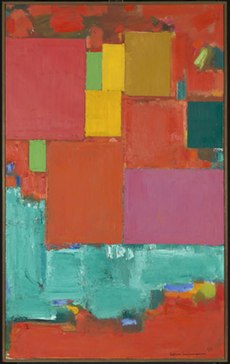
Hans Hofmann, Pompeii, oil on canvas, 84.25" 10 52.25", 1959.
Hofmann's art is more often than not distinguished by its rigorous concern with pictorial structure and unity, development of spatial illusion through the "push and pull" of color, shape and placement, and use of assuming, often primary color for expressive means.[4] In the offset decades of the century, he painted in a modernist, though yet identifiably representational style, creating landscapes, even so lifes and portraits largely influenced past Cubism and Cézanne in terms of form, and Kandinsky, Matisse and Van Gogh in terms of colour.[3] [2] He began an extended menstruum focused solely on drawing some time in the 1920s, returning to painting in 1935.[8] By 1940, however, he began to paint completely abstract works such equally Leap, a small oil on panel "drip" painting. Fine art historians accept described that work, and others such as The Wind (1942), Fantasia (1943) and Effervescence (1944), in terms of their "painterly attacks," jolting contrasts, rich color, and gestural spontaneity as "records of the artist's intense experience" of paint, color, and processes that were arbitrary, accidental and directly, as well as intentional.[i] They demonstrate Hofmann's early stylistic experimentation with the techniques that would be termed "action painting," which Pollock and others made famous by the end of the decade.[10] [6] Hofmann believed that abstract fine art was a way to go at important reality, once stating that "the ability to simplify ways to eliminate the unnecessary, so that the necessary may speak."[eleven]
Hofmann'south work in the 1940s was championed by several key figures who initiated a new era of growing influence for fine art dealers and galleries, including Peggy Guggenheim, Betty Parsons, and Samuel G. Kootz. His outset New York solo show at Guggenheim's Art of This Century gallery in 1944 was positively reviewed in the New York Times, ARTnews and Arts Digest.[six] Critic Clement Greenberg regarded that bear witness—and Jackson Pollock'southward a few months prior—every bit a "pause-out" from the "cramping hold of Synthetic Cubism" on American painting, which opened the path to the more painterly mode of abstract expressionism.[5] That same year, Hofmann was as well featured in a solo exhibition at The Arts Club of Chicago, and two key group shows of Abstract and Surrealist art in America, curated by Sidney Janis and Parsons. Reviewing a 1945 Hofmann showroom, Greenberg wrote, "Hofmann has go a force to be reckoned with in the do equally well equally in the interpretation of modern art."[6] Not all critics were uniform in praise; for example, Robert Coates, one of the start to call the new work "abstract expressionism," expressed skepticism about the "spatter-and-daub" mode of painting in a 1946 review of Hofmann's piece of work.[12] [5] In 1947, Hofmann began exhibiting annually at the Kootz Gallery in New York (and would do and so every year through 1966, except 1948 when the gallery temporarily closed), and over the next decade connected to proceeds recognition.[13]

"Open Alphabetic character to Roland L. Redmond, President of the Metropolitan Museum of Art." Hofmann was among a group who would get known as The Irascibles, 18 painters and 10 sculptors who in May 1950 sent an open alphabetic character to the Met, rejecting the museum's "monster national exhibition" to be held in Dec. Francis Henry Taylor, the Met'due south Managing director, they said, had "publicly declared his antipathy for modern painting," and Robert Beverly Hale, the Acquaintance Curator of American Art, has "accepted a jury notoriously hostile to avant-garde art."[14]
In his after period, Hofmann often worked less gesturally, creating works such as The Gate (1959–threescore), Pompeii (1959) or To Miz - Pax Vobiscum (a 1964 memorial after her death), that were loosely devoted to architectonic volumes and sometimes referred to as his "slab paintings."[15] [sixteen] In these works, he used rectangles of sensual colour that reinforced the shape of his consequent easel-painting format and sometimes suggested a modular logic, however escaped definitive readings through areas of modulated paint and irregular shapes.[17]
In 1957, the Whitney Museum put up a large retrospective on Hofmann, which traveled to 7 additional museums in the The states over the adjacent year. In his review of the retrospective, critic Harold Rosenberg wrote, "No American creative person could mountain a prove of greater coherent multifariousness than Hans Hofmann."[6] In 1960, Hofmann was selected to represent the Us at the Venice Biennale, aslope Philip Guston, Franz Kline and Theodore Roszak.[18] In 1963, The Museum of Modern Art gave a full-scale retrospective, organized by William Seitz, with a catalogue that included excerpts from Hofmann's writings.[3] The exhibit traveled in the next ii years to v other venues in the U.S., museums in Buenos Aires and Caracas, and finally to 5 venues in holland, Italy and Germany.
Posthumous retrospectives of Hofmann's work include shows at the Hirshhorn Museum (1976), Whitney Museum (1990), and London's Tate Gallery ("Hans Hofmann: Late Paintings," 1988), which was curated by the British painter John Hoyland. Hoyland first encountered Hofmann's work during his first visit to New York in 1964, in the visitor of Clement Greenberg, and had been immediately impressed.[nineteen]
Education [edit]
Hofmann was renowned not only as an artist only too every bit a teacher of art, both in his native Germany and later in the U.S. His value equally a instructor lay in the consistency and uncompromising rigor of his artistic standards and his ability to teach the fundamental principles of postwar brainchild to a various body of students.[fifteen] He founded his outset school, Schule für Bildende Kunst (Schoolhouse of Fine Fine art) in Munich in 1915, edifice on the ideas and piece of work of Cézanne, the Cubists, and Kandinsky. His hands-on teaching methods included ongoing word of art theory, life cartoon sessions, and regular critiques from Hofmann himself, a practice which was a rarity in the Academy.[six] By the mid-1920s, he attained a reputation every bit a forward-thinking teacher and was attracting an international assortment of students seeking more avant-garde instruction, including Alf Bayrle, Alfred Jensen, Louise Nevelson, Wolfgang Paalen, Worth Ryder,[xx] and Bistra Vinarova.[21] Art historian Herschel Chipp asserted that the school was probable the start school of modernistic art in existence.[2] Hofmann ran the schoolhouse, including summer sessions held throughout Germany, and in Austria, Croatia, Italy and France until he emigrated to the U.South. in 1932.
In the U.Due south., he initially taught a summer session at the University of California, Berkeley in 1930, at the invitation of former educatee Worth Ryder, then a member of the art faculty. He taught again at Berkeley and at the Chouinard Art Institute in Los Angeles the next year before again returning to Federal republic of germany.[22] [23] Subsequently relocating to New York Metropolis, he began teaching at the Art Students League of New York in 1933. Past 1934, Hofmann opened his own schools in New York and in Provincetown, Massachusetts. Many notable artists studied with him, including Lee Krasner, Helen Frankenthaler, Ray Eames, Larry Rivers, Allan Kaprow, Cerise Grooms, Nell Blaine, Irene Rice Pereira, Gerome Kamrowski, Ward Jackson, Fritz Bultman, Israel Levitan, Robert De Niro, Sr., Jane Freilicher, Wolf Kahn, Marisol Escobar, Burgoyne Diller, James Gahagan, Richard Stankiewicz, Linda Lindeberg, Lillian Orlowsky, Louisa Matthíasdóttir and Nína Tryggvadóttir.[24] [25] [26] Beulah Stevenson, a long-time curator at the Brooklyn Museum, was also among his pupils.[27] [28] In 1958, Hofmann closed his schools in gild to devote himself exclusively to his own creative work. In 1963, The Museum of Modern Art curated the traveling exhibit "Hans Hofmann and His Students," which included 58 works representing 51 artists.[29]
Despite being credited with didactics a number of the most gifted women artists of the period—at a time when they were notwithstanding somewhat rare—Hofmann has sometimes been described as exhibiting a "straightforward male chauvinist posture."[30] Lee Krasner, who remained a devotee, likened some of his critiques to the back-handed praise before women artists often experienced (for example, "so good, you'd never know information technology was done by a woman!").[30] Sculptor Lila Katzen has related that he told her that "merely men had the wings for art."[31]
Writing [edit]
Hofmann'southward influential writing on modernistic art have been collected in the book Search for the Real and Other Essays (1948), which includes his discussions of his push button/pull spatial theories, his reverence for nature as a source for art, his confidence that art has spiritual value, and his philosophy of art in general. In formal terms, he is especially noteworthy as a theorist of the medium who argued that "each medium of expression has its own order of being," that "colour is a plastic means of creating intervals," and his awareness of a painting's frame, represented past his quote, "any line placed on the canvass is already the fifth."[32] Hofmann believed in remaining faithful to the flatness of the canvass support, and that to suggest depth and move in a painting an artist must create what he called "button and pull" in the image—contrasts of color, form, and texture.
Hofmann held a strong confidence most the spiritual and social value of art. In 1932, he wrote: "Providing leadership by teachers and support of developing artists is a national duty, an insurance of spiritual solidarity, What we do for art, we do for ourselves and for our children and the future."[33]
Collections and art market [edit]
Hofmann's works are in the permanent collections of many major museums in the United States and throughout the world, including the: UC Berkeley Art Museum, Metropolitan Museum of Art, Solomon R. Guggenheim Museum, Whitney Museum, Museum of Modernistic Fine art, San Francisco Museum of Modern Fine art, Museum of Fine Arts Boston, Fine art Institute of Chicago, Seattle Art Museum, Baltimore Museum of Fine art, Museum of Fine Arts Houston, Cleveland Museum of Art, Philadelphia Museum of Art, Provincetown Art Clan and Museum, Städtische Galerie im Lenbachhaus (Munich), Museu d'Fine art Contemporani, (Barcelona), Tate Gallery, Fine art Museum of West Virginia University, and the Fine art Gallery of Ontario (Toronto). Hofmann also designed a public work, a colorful landscape located outside the entrance of the High School of Graphic Communication Arts located in the Hell'due south Kitchen neighborhood of Manhattan.[34]
In 2015, at a Christie's New York auction, Hofmann's Auxerre (1960), inspired by the expansive stained glass windows of the Cathédrale Saint Etienne in France, accomplished a globe auction record for the artist at $6,325,000.[35]
Hofmann Estate [edit]
When Hofmann died on February 17, 1966, his widow, Renate Hofmann, managed his Manor. After Renate'due south decease in 1992, the New York Daily News published an article titled, "From Caviar to Cat Nutrient," which detailed the "sad and tortuous story" of Hofmann'south widow. The article contended that Renate's court appointed guardians "milk[ed] the Estate for more than a decade" and allowed the mentally unstable Renate to alive "with her cats and liquor in a garbage-strewn oceanfront dwelling house."[36] Under threat of prosecution, the original executor of the Hofmann Estate, Robert Warshaw, was successful in having the neglectful guardians pay $8.7 million to the Manor for "extraordinary conscious pain and suffering."[36]
Under the will of Renate Hofmann, The Renate, Hans and Maria Hofmann Trust was formally created with Warshaw at its head. The mission of the Trust is "to promote the written report and understanding of Hans Hofmann's boggling life and works" and to attain these goals "through exhibitions, publications and educational activities and programs focusing on Hans Hofmann"[37] equally well every bit a catalogue raisonné of Hofmann's paintings.[38] The U.S. copyright representative for the Renate, Hans and Maria Hofmann Trust is the Artists Rights Club.[39]
See also [edit]
- Abstruse art
- Abstract Imagists
- Fine art theory (aesthetics)
- Color field
- Modernism
- The Irascibles
- Western painting
References [edit]
- ^ a b de la Croix, Horst and Richard Yard. Tansey. Gardner'southward Art Through the Ages, 7th Ed., New York: Harcourt Brace Jovanovich, 1980, p. 857-8.
- ^ a b c d e f yard Chipp, Herschel B. Theories of Modern Art, Berkeley & Los Angeles: Academy of California Printing, 1968, p. 511–2.
- ^ a b c Seitz, William C. Hans Hofmann, New York: Museum of Modern Art, 1963.
- ^ a b c Harrison, Charles and Paul Wood. Art in Theory: 1900–1990, Cambridge: Blackwell Publishers, 1992, p. 354.
- ^ a b c Greenberg, Clement. "After Abstract Expressionism," Fine art International, Vol. VI, No. 8, October 1962.
- ^ a b c d e f one thousand h i j k l Hans Hofmann.org. Biographical Chronology. Hans Hofmann.org. Retrieved June 25, 2018.
- ^ Hofmann, Hans. Search for the Real and Other Essays, eds. South. T. Weeks and B. H. Hayes, Jr., Cambridge: 1000.I.T. Press, Addison Gallery of American Art, 1948.
- ^ a b c Guggenheim Museum. Hans Hofmann, Collection Online. Retrieved June 26, 2018.
- ^ Tate. Academie Colarossi, Tate.org. Retrieved June 25, 2018.
- ^ Berkeley Art Museum "The Making of a Modernist: Hans Hofmann," Retrieved June 26, 2018.
- ^ "Hans Hofmann: Quotes". www.hanshofmann.net . Retrieved vii February 2018.
- ^ Coates, Robert M. 'The Art Galleries', New Yorker, March 30, 1946, p.83.
- ^ Smithsonian Establishment, Archives of American Fine art: Kootz Gallery records, 1923–1966.(http://www.aaa.si.edu/collections/kootz-gallery-records-9163. Retrieved 16 Nov. 2012.
- ^ "18 Painters Boycott Metropolitan; Accuse 'Hostility to Advanced Art'". The New York Times. 22 May 1950. pp. 1, 5. Retrieved i Apr 2021.
{{cite news}}: CS1 maint: url-condition (link) - ^ a b Guggenheim Museum. Hans Hofmann, The Gate, Drove Online, 1959–60. Retrieved June 26, 2018.
- ^ The Art Story. Works by Hans Hofmann. Retrieved June 26, 2018.
- ^ Warner, Emily. Pompeii, 1959 by Hans Hofmann, Tate Modern, Research Publications. Retrieved June 26, 2018.
- ^ Baltimore Museum of Fine art. Installation view, paintings past Franz Kline and Hans Hofmann, Venice Biennale, 1960, The Baltimore Museum of Art Library and Archives. Retrieved June 25, 2018.
- ^ Lambirth, Andrew (2009). John Hoyland: Scatter the Devils. Unicorn Press, p. 74.
- ^ Karl Kasten on Worth Ryder retrieved online October 27, 2008 Archived November 21, 2008, at the Wayback Auto
- ^ "Неизвестната Бистра Винарова" [The Unknown Bistra Vinarova]. Kultura Bulgaria (in Bulgarian). Sofia, Bulgaria: Култура. three September 2013. Archived from the original on 19 October 2013. Retrieved 16 April 2017.
- ^ Hofmann Chronology, retrieved October 27, 2008 Archived December 2, 2008, at the Wayback Machine
- ^ BAM/PFA – Fine art Collection Archived June nine, 2007, at the Wayback Automobile
- ^ "Hans Hofmann and his students 1963–1964."'Hans Hofmann and his students, New York : Museum of Modernistic Art, 1963–1964"
- ^ "Color Creates Low-cal: Studies with Hans Hofmann – Partial Listing of Hofmann Students Per Era"[one]"
- ^ Jules Heller; Nancy G. Heller (xix December 2013). Northward American Women Artists of the Twentieth Century: A Biographical Lexicon. Routledge. ISBN978-1-135-63882-v.
- ^ People Reading: Selections from the Collection of Donald and Patricia Oresman. Spartanburg Art Museum. 2008.
- ^ "Beulah Stevenson – Peyton Wright Gallery". Retrieved 29 October 2017.
- ^ Museum of Modernistic Art (New York, N.Y.) (vii Feb 1963). Hans Hofmann and his students. Museum of Modernistic Art. OCLC 79041676.
- ^ a b Gaze, Delia (Editor). Dictionary of Women Artists, Routledge, 1997.
- ^ Tighe, Mary Ann. "Restoring the Lost Art of Women Painters," Washington Post, October 28, 1979. Retrieved June 25, 2018.
- ^ Hofmann, Hans. Search for the Existent and Other Essays, ed. Sara T. Weeks and Bartlett H. Hayes, Jr., Cambridge, Massachusetts: M.I.T. Printing, 1967.
- ^ Hofmann, Hans. "Painting and Culture," in Search for the Real and Other Essays, ed. Sara T. Weeks and Bartlett H. Hayes, Jr., Cambridge, Massachusetts: M.I.T. Press, 1967, p. 58.
- ^ Yous're in Hell'south Kitchen: High Schoolhouse of Graphic Communication Arts Archived June 24, 2007, at the Wayback Auto
- ^ Hans Hofmann, Auxerre (1960) Christie'southward Post-War and Gimmicky Art Evening Sale, 13 May 2015, New York.
- ^ a b "artnet.com Magazine News". ps-ca-spider web-02.artnet-spider web.artnet.com . Retrieved 7 Feb 2018.
- ^ Hans Hofmann.org. The Artist. Hans Hofmann.org. Retrieved June 25, 2018.
- ^ The Renate, Hans and Maria Hofmann Trust website: catalogue raisonné page Archived June x, 2008, at the Wayback Machine
- ^ Most frequently requested artists list of the Artists Rights Lodge Archived January 31, 2009, at the Wayback Machine
Sources [edit]
- Chipp, Herschel B.. Theories of modern art; a source volume by artists and critics (Berkeley, Academy of California Press, 1968)
- Greenberg, Clement. Hofmann (Paris, Editions Georges Fall, 1961).
- Hofmann, Hans; Sara T Weeks; Bartlett H Hayes; Addison Gallery of American Art; Search for the real, and other essays (Cambridge, Massachusetts, M.I.T. Press, 1967) OCLC 1125858
- Lambirth, Andrew (2009-10-01). John Hoyland: Scatter the Devils. Unicorn Printing. ISBN978-one-906509-07-1.
- Tapié, Michel. Hans Hofmann : peintures 1962 : 23 avril-18 mai 1963. (Paris: Galerie Anderson-Mayer, 1963.) [exhibition catalogue and commentary] OCLC: 62515192
- Cynthia Goodman, Hans Hofmann : in conjunction with the exhibition "Hans Hofmann"; Whitney Museum of American Art, New York, June 20, 1990 – September 16, 1990; Center for the Fine Arts, Miami, November 1990 – January 1991; The Chrysler Museum, Norfolk, Virginia, February 1991 – April 1991 (München : Prestel, 1990.) ISBN 0-87427-070-7
- Marika Herskovic, American Abstract Expressionism of the 1950s An Illustrated Survey, (New York School Press, 2003.) ISBN 0-9677994-1-4. pp. 166–169
- —, New York School Abstract Expressionists Artists Choice past Artists, (New York School Press, 2000.) ISBN 0-9677994-0-half dozen. p. 16; p. 37; pp. 182–185
- ART USA Now Ed. by Lee Nordness;Vol.1, (The Viking Printing, Inc., 1963. pp. 18–21
External links [edit]
- The Estate of Hans Hofmann
- Hans Hofmann Biography: Guggenheim Collection (New York)
- Hans Hofmann Biography: Tate Collection (Tate Gallery, London)
- Hans Hofmann Biography: PBS.org
- Information on Hans Hofmann: Askart.com
- PBS interactive pages on Hans Hofmann'due south "button/pull" theory
- A Finding Aid to the Hans Hofmann papers, circa 1904-2011, bulk 1945-2000 in the Athenaeum of American Art, Smithsonian Institution
- Hoffmann works from the collection at the San Francisco Museum of Mod Art. Retrieved 2010-08-xiii.
Source: https://en.wikipedia.org/wiki/Hans_Hofmann
0 Response to "Artist Hans Hofmann Was Known for Art Full of Colors and Shapes Macaroni Glue"
Postar um comentário